

[P35] Land mines dataset, UCI ML repository, and default XGB params
Resources from the Classification section of the Tabular Foundation Models book.

I was reading the classification section of the Tabular Foundation Models book. I found the following useful resources there.
Land Mines dataset (Yilmaz, Kahraman, and Söyler 2018)
While there are plenty datasets on Kaggle, I often have trouble figuring out which one is reliable. Since this dataset is being used in the book, I am assuming it has passed some quality filter and is reliable. I asked Google whether this dataset is good and popular and got the following answer:
Is this a good and popular dataset?
Yilmaz, Cemal, Hamdi Tolga Kahraman, and Salih Söyler. 2018. “Passive Mine Detection and Classification Method Based on Hybrid Model.” IEEE Access 6: 47870–88. https://doi.org/10.1109/ACCESS.2018.2866538.
Yes, the dataset associated with this paper is considered a high-quality, reputable, and popular benchmark specifically for passive landmine detection.
Commonly referred to as the “Land Mines Dataset”, it was officially archived in the prestigious UCI Machine Learning Repository.
Why It Is Considered a “Good” Dataset
High-Quality Real Data: Instead of pure simulations, it features authentic experimental data collected via a uniquely designed framework using an FLC-100 magnetic field sensor.
Multi-Feature Input Space: It maps a concise, yet highly predictive, three-dimensional feature space consisting of voltage readings (magnetic field anomalies), sensor height, and soil types (factoring in moisture across 6 distinct conditions).
Multiclass Classification: It allows models to classify five distinct types of mines (based on metallic, semi-metallic, and plastic compositions) alongside a “no-mine” baseline, making it much more robust than standard binary threat datasets.
Popularity and Academic Adoption
UCI Archival: Because it is hosted on the UCI Machine Learning Repository—a gold standard platform for data scientists—it is highly discoverable and frequently downloaded.
Benchmark Standard: Researchers consistently use this exact dataset to benchmark newer neural network architectures, such as Kolmogorov-Arnold Networks (KANs) and optimized Deep Neural Networks (DNNs).
High Sphericity: The underlying paper published in IEEE Access is highly regarded in the niche field of non-invasive, passive ordnance detection.
Minor Constraints to Keep in Mind
While excellent, it is a relatively compact dataset (the baseline contains 338 authentic measurements). Modern deep learning papers using it often apply data augmentation (like injecting minor Gaussian noise) to artificially expand the sample distribution safely before training.
It doesn’t have missing values, though.
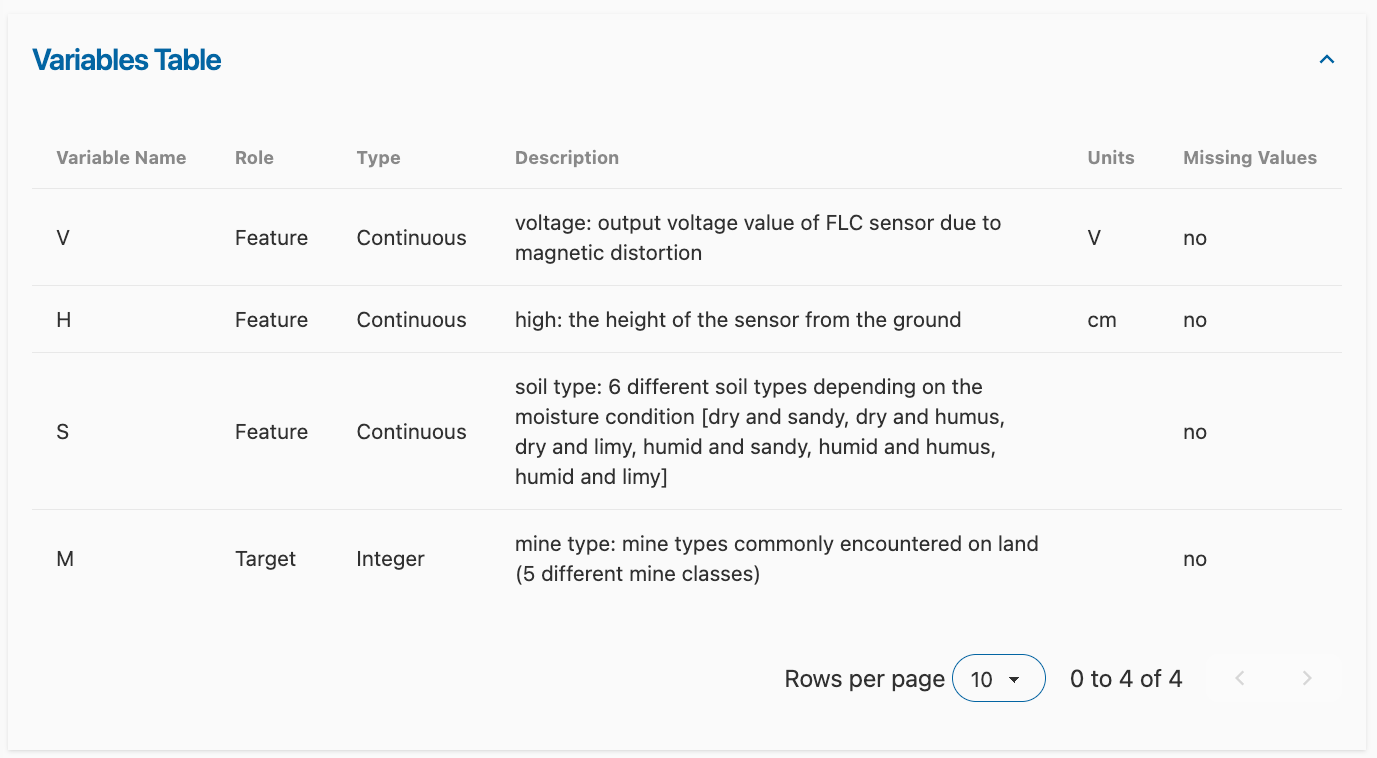
The small size of the dataset also prompted me to double check whether such a small size is appropriate for tabular foundation models. The official documentation of TabICLv2 says the following.
What dataset sizes work well?
TabICLv2 is pre-trained on datasets with 300 to 60K training samples. However, it can generalize beyond this range and we have observed good performance on datasets with 600K samples. Generalization to datasets smaller than 300 samples has not yet been tested.
UC Irvine Machine Learning Repository
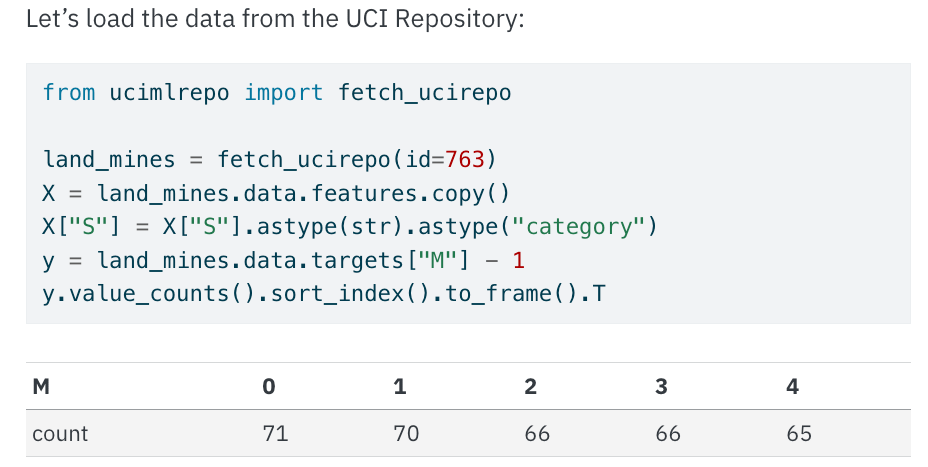
I also didn’t know about the UC Irvine Machine Learning Repository. We can fetch data directly in code.
XGBoost hyperparameters that matter most according to Probst, Boulesteix, and Bischl (2019)
I can see the relevance of this paper. I skimmed it and stared at Table 3 for a while. I need a more careful reading before I can say anything.