

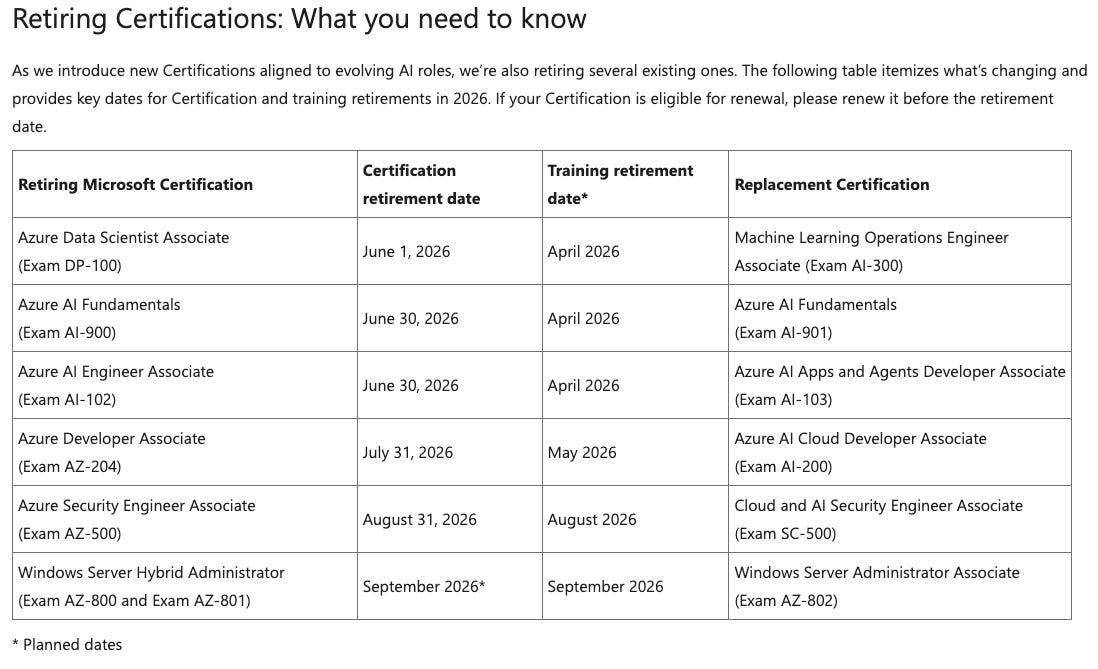
[P36] Microsoft DS Associate Certificate (DP-100) Replaced with ML Ops Eng. Associate (AI-300)
Indicating that traditional data scientists need to skill up and transition into increasingly engineering-heavy roles.

Employers often ask for experience with cloud services and professional certifications help demonstrate skills. For this reason, I searched for the DP-100 Microsoft Azure Data Scientist Associate Certificate so I could develop my skills while having this exam as the north star. It tested the following skills:
Source: https://learn.microsoft.com/en-us/credentials/certifications/resources/study-guides/dp-100
Skills measured as of April 11, 2025
Audience profile
As a candidate for this exam, you should have subject matter expertise in applying data science and machine learning to implement and run machine learning workloads on Azure. Additionally, you should have knowledge of optimizing language models for AI applications using Azure AI.
Your responsibilities for this role include:
Designing and creating a suitable working environment for data science workloads.
Exploring data.
Training machine learning models.
Implementing pipelines.
Running jobs to prepare for production.
Managing, deploying, and monitoring scalable machine learning solutions.
Using language models for building AI applications.
As a candidate for this exam, you should have knowledge and experience in data science by using:
Azure Machine Learning
MLflow
Azure AI services, including Azure AI Search
Azure AI Foundry
Skills at a glance
Design and prepare a machine learning solution (20–25%)
Explore data, and run experiments (20–25%)
Train and deploy models (25–30%)
Optimize language models for AI applications (25–30%)
I learned that this course was retired in June 2026 and the Machine Learning Operations Engineer Associate (Exam AI-300) Certificate replaced it. This is yet another evidence for the AI boom-induced evolution in this field. It seems the first three bullet points listed under “Skills at a glance” above are not as valuable now as they were before the agentic era.
The new certificate tests the following skills:
Source: https://learn.microsoft.com/en-gb/credentials/certifications/resources/study-guides/ai-300
Skills measured
Audience profile
As a candidate for this Microsoft Certification, you should have subject matter expertise in setting up infrastructure for machine learning operations (MLOps) and generative AI operations (GenAIOps) solutions on Azure, together referred to as AI operations (AIOps). You need experience training, optimizing, deploying, and maintaining traditional machine learning models by using Azure Machine Learning, in addition to experience deploying, evaluating, monitoring, and optimizing generative AI applications and agents by using Microsoft Foundry.
You should have a data science background with experience in Python programming and an entry-level understanding of DevOps practices, including using tools like GitHub Actions and working with command-line interfaces (CLIs).
Additionally, you need knowledge and experience in MLOps by using:
Machine Learning.
Foundry.
GitHub Actions.
Infrastructure as code (IaC) practices with Bicep and Azure CLI.
Your responsibilities for this role include:
Designing and implementing MLOps infrastructure.
Implementing machine learning model lifecycle and operations.
Designing and implementing GenAIOps infrastructure.
Implementing generative AI quality assurance and observability.
Optimizing generative AI systems and model performance.
You work with data scientists, DevOps teams, and stakeholders to deliver scalable AI solutions with comprehensive automation and monitoring.
Skills at a glance
Design and implement an MLOps infrastructure (15–20%)
Implement machine learning model lifecycle and operations (25–30%)
Design and implement a GenAIOps infrastructure (20–25%)
Implement generative AI quality assurance and observability (10–15%)
Optimize generative AI systems and model performance (10–15%)
I think this change clearly indicates that traditional data scientists need to skill up and transition into increasingly engineering-heavy roles.